












Purbaya Optimistic about 5-6 Percent GDP Growth amid Slowdown
Indonesia’s economy grew 5.29 percent year-on-year in the second quarter of 2026, slowing from 5.61 percent the previous quarter but still above the 5.12 percent recorded a year earlier, Statistics Indonesia (BPS) said on Aug 5.
Finance Minister Purbaya Yudhi Sadewa said on Aug 3 that second-quarter growth would be “not far from 5.4 percent.” He stood by the government’s full-year forecast of 5.6-6.0 percent.
Speaking after a Financial System Stability Committee (KSSK) meeting, Purbaya attributed the slowdown partly to higher global oil prices and geopolitical tensions in the Middle East. He said economic activity was expected to strengthen in the second half through closer coordination between the government and Bank Indonesia.
BPS Deputy for National Accounts and Statistical Analysis M. Edy Mahmud said gross domestic product was Rp 6,552.1 trillion ($365.6 million) at current prices and Rp 3,576.2 trillion at constant prices during the quarter.
Manufacturing remained the largest contributor to GDP at 18.50 percent, followed by agriculture at 13.57 percent, trade at 13.02 percent, construction at 9.79 percent and mining at 8.87 percent.
The KSSK said authorities would maintain adequate financial-system liquidity to support lending and investment, while accelerating state spending and continuing measures to support household consumption.
Since taking office, Purbaya has transferred hundreds of trillions of rupiah in excess government cash from BI to state-owned banks, arguing that additional liquidity would help stimulate lending and economic activity.
Meanwhile, inflation has cooled down, despite ongoing pressure from high global oil prices, according to BPS. Consumer price index growth slowed to 2.88 percent year-on-year in July, BPS official Ateng Hartono said on Aug 3, within Bank Indonesia’s target range of 2.5 percent plus/minus 1 percent.
Related Links:
- https://news.ddtc.co.id/berita/nasional/1821401/bps-pertumbuhan-ekonomi-kuartal-ii2026-capai-529
- https://www.cnbcindonesia.com/news/20260805101818-4-756670/pertumbuhan-ekonomi-indonesia-kuartal-ii-2026-capai-529
- https://www.thejakartapost.com/business/2026/08/04/purbaya-forecasts-high-gdp-growth-this-year?utm_source=(direct)&utm_medium=channel_business
- https://www.thejakartapost.com/business/2026/08/03/inflation-eases-despite-pressure-from-oil-prices?utm_source=(direct)&utm_medium=home_popular
- https://finance.detik.com/berita-ekonomi-bisnis/d-8602532/purbaya-sebut-ekonomi-ri-tahan-banting-di-tengah-gejolak-global#google_vignette
- https://en.tempo.co/read/2116604/indonesias-financial-sector-stable-for-q2-of-2026-says-purbaya
BI Wants to Spur Commercial Lending Growth
Bank Indonesia has announced a new policy intended to discourage commercial banks from placing excess liquidity in Bank Indonesia's securities and instead push them to increase lending, acting BI Governor Destry Damayanti said on Aug 3.
Destry spoke at a press conference held by the Financial System Stability Board (KSSK), which is comprised of the finance minister, BI governor, Financial Services Authority (OJK) chair and Deposit Insurance Corporation (LPS) chair.
The board held its regular quarterly meeting on July 28, the first since Perry %u2060Warjiyo's sudden departure as BI governor on July 27.
Perry’s resignation sparked unease among investors over fiscal policy and BI’s independence. President Prabowo Subianto has yet to nominate a successor for Perry, a decision that will be closely watched by market observers.
During its July policy review, still chaired by Perry, BI announced a 200 basis point reduction in the required reserve levels for banks that place less than 19 percent of their funds in government bonds and BI's rupiah-denominated securities, known as SRBI, effective September 1.
"We want SRBI to be a liquidity management tool, not an investment instrument [for banks]," Destry said %u2060at the press conference, adding that BI wanted to use SRBI to attract foreign capital inflows.
BI has reduced the level of outstanding SRBI in the market to around 1,050 trillion rupiah ($58.40 billion) as of Friday, down from 1,097 trillion rupiah on July 16, she said.
Speaking beside Destry at the press conference, Finance Minister Purbaya Yudhi Sadewa said liquidity was%u2060 discussed at the KSSK meeting and that there would be no more debate about the issue.
Destry said at the press conference that BI’s higher interest rates had helped stabilize the rupiah, which is currently trading at around 17,950 to the US dollar after spending weeks below 18,000.
Meanwhile, higher interest rates are raising funding costs and squeezing the net interest margin (NIM) of banks. Banks’ interest margins narrowed to an average of 4.34 percent in June, down from 4.36 percent in May and 4.48 percent in June 2025, according to OJK data cited by The Jakarta Post.
In the May-June period, BI raised its benchmark rate, bringing it to the current level of 5.75 percent. Bank Central Asia as well as state-owned Band Mandiri and Bank Tabungan Negara (BTN) all posted lower NIMs in recent financial reports.
Related Links:
- https://www.reuters.com/world/asia-pacific/bank-indonesia-wants-more-lending-commercial-banks-acting-governor-says-2026-08-03/
- https://m.antaranews.com/amp/berita/5678351/bi-kepemilikan-srbi-oleh-bank-guna-kelola-likuiditas-bukan-investasi
- https://investor.id/market/448970/destry-rupiah-lebih-stabil-setelah-birate-naik-ke-575
- https://www.thejakartapost.com/business/2026/08/04/rising-interest-rates-take-toll-on-bank-margins?utm_source=(direct)&utm_medium=home_headlines
Indonesian Manufacturing Inches Back in July
Indonesia’s manufacturing sector just barely returned to expansionary territory in July, with the S&P Global Indonesia Purchasing Managers’ Index (PMI) rising to 50.2 from 46.9 in June. A figure above 50 indicates expansion.
The improvement was driven by the first increase in factory output since February, supported by stronger customer confidence and more stable domestic demand. New orders stabilized, while manufacturers increased hiring for the first time in five months as backlogs rose at their fastest pace since November 2025.
However, the recovery remained modest. Export orders declined for a fifth consecutive month, while high raw material costs, supply constraints and competitive pressures continued to weigh on demand and purchasing activity.
S&P Global Market Intelligence economist Usamah Bhatti said improved customer confidence was beginning to support the sector, although elevated prices limited the recovery.
“Signs of improving customer confidence are beginning to emerge. However, a stronger recovery is still being held back by elevated prices,” Bhatti said on Aug 3, adding that easing input cost inflation suggested price pressures may have peaked.
Experts have raised concerns about the long-term state of Indonesian manufacturing. Institute for Development of Economics and Finance (INDEF) economist Muhammad Rizal Taufikurahman said the marginal reading above 50 reflected a short-term rebound rather than a fundamental recovery, urging the government to strengthen demand and industrial competitiveness.
Permata Bank Chief Economist Josua Pardede said the improvement largely reflected a low base following June’s sharp contraction.
“What we are seeing is more of an end to the decline than the start of a strong industrial upswing,” Josua told The Jakarta Post on Aug 3. He said a sustained recovery would require lower raw material and production costs, as well as stronger domestic and export demand.
Related Links:
- https://www.thejakartapost.com/business/2026/08/03/manufacturing-back-in-expansion-zone-but-export-woes-linger
- https://www.cnbcindonesia.com/research/20260803074142-128-755892/kabar-baik-awal-agustus-pmi-manufaktur-ri-bangkit-pabrik-tambah-staf
- https://industri.kontan.co.id/news/pmi-manufaktur-kembali-ekspansi-indef-belum-jadi-titik-balik-pemulihan-industri
Indonesia Eases Rare Earth Export Rules as Industry Complains
Seeking to calm angry companies, the government is allowing exports of mineral commodities, including nickel and tin downstream products, to resume this week after clarifying that the export ban on rare earth elements (REE) applies only to primary products, not byproducts used with other minerals, said Presidential Chief of Staff Dudung Abdurachman on Aug 3.
“We have reached a common understanding that the REE export ban applies to REE as the main product. It does not automatically apply to REE contained as incidental elements in primary mining products and their derivatives,” Dudung said.
The announcement comes as the government revises regulations on minerals containing REE. Dudung said the policy is a transitional guideline for exporters, surveyors, and customs officials while the government strengthens legal certainty.
State-owned testing and inspections company Sucofindo is to issue 85 delayed survey reports, mostly covering alumina, copper cathodes and nickel-derived products.
Dudung said officials will convene ministries, agencies, academics and industry representatives to determine REE content thresholds, testing methods, verification procedures, and surveyor guidelines, emphasizing that law enforcement should not create uncertainty for businesses.
Energy and Mineral Resources Minister Bahlil Lahadalia said that exports were delayed because downstream products such as nickel and copper were found to contain REE byproducts, despite Indonesia lacking specific regulations for them.
“We are mapping this carefully so investors can continue operating while we establish a proper framework for managing rare earth elements,” Bahlil told reporters on Aug 3.
The Chairman of the Indonesian Nickel Industry Forum, Arif Perdanakusumah, said regulatory uncertainty has added more pressure to an industry already facing rising production costs.
“We are bleeding. The geopolitical situation in the Middle East has had an extraordinary impact on our production costs,” Arif said, noting that sulfur prices surged from around $220 per metric ton in 2025 to around $1,200 per metric ton currently.
Related Links:
- https://www.thejakartapost.com/business/2026/08/04/indonesia-lifts-export-freeze-on-rare-earth-byproducts
- https://nasional.kompas.com/read/2026/08/03/10071331/pemerintah-larang-ekspor-logam-tanah-jarang-sebagai-produk-utama
- https://www.cnbcindonesia.com/news/20260803100949-4-755948/tok-pemerintah-sudah-buka-lagi-keran-ekspor-mineral-nikel-cs
- https://finance.detik.com/energi/d-8602810/bahlil-buka-suara-soal-eskpor-tertahan-karena-aturan-logam-tanah-jarang
- https://tradingeconomics.com/commodity/sulfur
Indonesia Surpasses 290 Million People
Indonesia’s population has passed the 290 million milestone, with nearly seven in 10 citizens of working-age, thus giving the country a major demographic advantage at a time when many more developed societies are facing aging populations.
Government data for the first half of 2026 put the population at 290.13 million, up from 288.32 million six months earlier.
Of that total, 201.06 million people, or 69.30 percent, are between the ages of 15 and 64. Children below age 14 account for 65.96 million, or 22.74 percent, and 23.10 million people, or 7.96 percent, are above age 65.
“This is a major opportunity that not every country has,” said Teguh Setyabudi, the director general of civil registration at the Home Ministry, during the release of the data on July 3.
The demographic bonus will only be a benefit, he said, if the government can deliver quality education, healthcare and enough employment opportunities for the working-age population.
Beyond the headline figures, the data offers some intriguing glimpses into the birthdays and names of Indonesians.
With 34.78 million people born under Cancer that is Indonesia’s most common zodiac sign. Taurus follows with 26.49 million and Gemini with 26.08 million. Aquarius is the least common, with just over 20 million.
January was the most common birth month and Thursday the most common birth day, with 144,182 births.
The data also looks at evolving naming trends.
Among millennials, Herman was the most common male name and Nurhayati the most common female name. For Generation Z, the most common names were Ardiansyah and Sri Wahyuni. Among Generation Alpha, Muhammad Alfatih topped the list for boys, while Siti Aisyah was the most common name for girls.
Also on the rise are celebrity-derived names such as Ariana Grande, Selena Gomez and Taylor Swift. There are 15,281 Arianas, 5,533 Selenas, and 153 Taylors.
Anime characters have also inspired names, with 190 people named Uzumaki, after the protagonist of Naruto.
West Java remains the most populous province with 52,211,020 people, followed by East Java at No. 2 with 42,226,212 people. Indonesia is the 4th most populous country in the world.
There are also some very old residents in the data, including one person listed at 118 and another at 117, both in Madura.
Related Links:
- https://jakartaglobe.id/news/indonesia-surpasses-290-million-people-here-are-the-quirky-facts-you-didnt-know
- https://www.cnbcindonesia.com/lifestyle/20260804140159-33-756451/dukcapil-ungkap-nama-unik-warga-ri-nobita-naruto-hingga-taylor-swift
- https://news.detik.com/berita/d-8603425/dukcapil-zodiak-penduduk-indonesia-paling-banyak-cancer-gemini-urutan-3
- https://www.cnnindonesia.com/nasional/20260804155627-20-1388524/dirjen-dukcapil-catat-penduduk-ri-capai-290-juta-jiwa-per-juni-2026#goog_rewarded
Member Announcement | Bank HSBC Indonesia
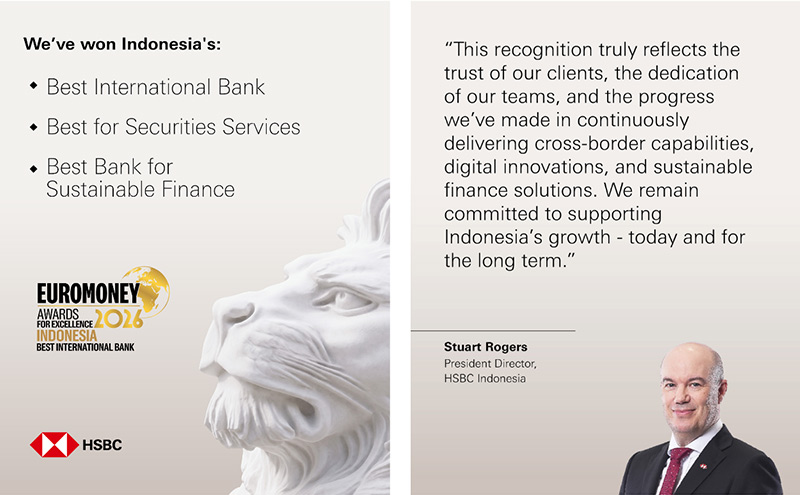
HSBC Indonesia Receives Multiple Euromoney Awards for Excellence 2026
In 2026, HSBC Indonesia was named Best International Bank in Indonesia at the Euromoney Awards for Excellence 2026. The bank was also named Best Bank for Sustainable Finance and Best Bank for Securities Services.
The awards recognize HSBC Indonesia’s strength in connecting global investors with the Indonesian market and facilitating cross-border capital flows for corporate and institutional clients.
In 2025, HSBC Indonesia further strengthened its position by leveraging its international connectivity and participating in significant capital market activities, including leading Indonesia’s first offshore renminbi bond issuance. The bank also continued to support major financing projects for corporations and state-related entities while providing expertise to help Indonesian companies expand internationally.
HSBC Indonesia differentiated itself through its strong international network and dedicated corridor teams, particularly for China-based clients. The continued development of its digital banking services enhanced transaction efficiency while reinforcing the bank’s role in supporting foreign investment and sustainable economic growth in Indonesia.
HSBC also received multiple recognitions across regions at the Euromoney Awards for Excellence 2026, including the Banker of the Year award for Group CEO Georges Elhedery.
Get to Know Our Members | ILLUMINA, INC.
 |
Illumina is a leading developer, manufacturer, and marketer of life science tools and integrated systems for the large-scale analysis of genetic variation and function. These systems enable studies that were unimaginable just a few years ago and bring us closer to realizing personalized medicine. Its customers include a broad range of academic, government, pharmaceutical, biotechnology and other leading institutions around the world.
Now is the Time to Join AmCham!
 |
We offer a full slate of meetings, events, and information for our community. But we can only do this through the support of our members. If you are not yet an AmCham member please join now.
AmCham Indonesia is open to all companies with an interest in US business relations and we have many non-American members.
We are a community and we welcome you!
Reach us at membership@amcham.or.id or click below!
Update is AmCham’s regular newsletter on developments related to investment, the economy, regulations and issues related to doing business in Indonesia. It comes out three times a week. It is edited by AmCham Managing Director Donna Priadi and written by the AmCham Staff.