












Regional Leaders Stew About Cuts ahead of 2027 State Budget
Stretched by cuts in government transfers to the regions under President Prabowo Subianto, local leaders are warning that shrinking transfers and delays in disbursing revenue-sharing funds (DBH) are leaving them struggling.
Experts say the austerity drive of the past 18 months has been put into sharp relief by the continued large spending on the central government's flagship initiatives. The regions are waiting to see if Subianto will reduce transfers further in the 2027 state budget, which is to be revealed Aug 14.
Several regions also have reported that DBH disbursements have been either delayed or only partially released, which disrupts budget management, according to the Association of Indonesian Regencies (Apkasi).
"Frankly, anxiety and uncertainty have become widespread among us as we carry out our duties as regional leaders,” Apkasi chairman Bursah Zarnubi told a hearing of House of Representatives (DPR) Commission II on July 30.
“We hope there will be no further cuts in 2027 so we can accelerate infrastructure development, improve public services and support national strategic projects,” Bursah said.
Bandung District Head Dadang Supriatna told the DPR that his administration has lost around Rp 1 trillion (US$55.5 million) in transfers and is struggling to meet its obligations. Surabaya Mayor Eri Cahyadi warned that raising local taxes to compensate would discourage investment and erode public trust.
The fiscal strain follows sweeping austerity measures Subianto introduced after taking office in October 2024 to fund his flagship programs. Regional transfers fell to Rp 693 trillion in 2026 down about 20 percent from Rp 869 trillion in 2025.
The government plans to raise transfers up to Rp 810 trillion in 2027, according to the draft macroeconomic projection and fiscal policy (KEM-PPKF) for next year’s state budget.
Responding to the complaints, Home Minister Tito Karnavian said he would urge the Finance Ministry to immediately release about Rp 70 trillion in outstanding DBH owed to regional governments through the 2024 fiscal year.
But Tito also said local governments should not depend solely on transfers.
“Regional leaders must have an entrepreneurial mindset instead of depending entirely on their bureaucracy,” Tito said. “If local revenue increases, regional budgets become stronger and development for the people can continue. That is a win-win solution.”
Related Links:
- https://www.thejakartapost.com/business/2026/08/02/regional-leaders-anxious-over-transfer-cuts-revenue-share-delays
- https://investortrust.id/macro/111167/apkasi-minta-pemerintah-pusat-hentikan-pemotongan-anggaran-daerah-pada-2027
- https://ekonomi.bisnis.com/read/20260803/10/1992951/efek-berantai-pemangkasan-tkd-belanja-pembangunan-hingga-gaji-pegawai-pemda-tersendat
- https://www.tempo.co/politik/tkd-2027-dipotong-arus-kas-daerah-2272237
Indonesia Prepares for Approaching El Niño
The government is stepping up preparations to mitigate the impact of the El Niño weather phenomenon by deploying targeted task forces, expanding weather modification operations (OMC) and strengthening water resilience.
The measures were discussed during a limited cabinet meeting chaired by President Prabowo Subianto on July 28, where he instructed his administration to safeguard water supplies and intensify efforts to prevent forest and land fires.
El Niño is a climate pattern marked by warmer oceans, weaker trade winds, and global weather shifts.
Teuku Faisal Fathani, Head of the Meteorology, Climatology, and Geophysics Agency (BMKG), said Indonesia has entered a strong El Niño phase that could bring drier-than-usual conditions across much of the country. The dry season is expected to peak in August, with the highest risk of fires occurring in August and September.
“We are focusing on securing water availability through OMC while also preventing forest and peatland fires by keeping vulnerable areas wet,” Faisal said on July 28.
BMKG has identified Riau, West Kalimantan, Central Kalimantan, South Sumatra, and Jambi as priority provinces requiring intensified monitoring.
Coordinating Minister for Infrastructure and Regional Development Agus Harimurti Yudhoyono said the government is expanding weather modification efforts, and may use drone technology to improve its effectiveness.
BMKG also called for stronger mitigation efforts across key sectors, as the prolonged dry season is expected to increase electricity demand while reducing hydropower generation. The agency has advised the energy ministry, state electricity company PLN, and dam operators to adjust water management based on real-time climate data.
Separately, to strengthen food security, the Ministry of Agriculture has distributed 100,000 water pumps, rehabilitated 900,000 hectares of irrigation networks, deployed drought-resistant seeds and expanded the use of moisture-retaining swampland.
As of July, BMKG recorded 5,019 wildfire hotspots in Kalimantan, Riau and Papua. Hotspot growth is accelerating faster than during previous El Niño events in 2015, 2019, and 2023.
Related Links:
- https://en.antaranews.com/news/424896/indonesia-stepping-up-drought-response-as-el-nino-lingers
- https://www.bmkg.go.id/berita/utama/bmkg-perkuat-antisipasi-dampak-el-nino-2026-fokus-jaga-ketersediaan-air-dan-cegah-karhutla
- https://www.tempo.co/politik/strategi-pemerintah-untuk-hadapi-ancaman-el-nino-2278898


Trade and Logistics Committee Explores Export Reforms
AmCham Indonesia, through its Trade and Logistics Committee, convened a discussion titled “Understanding Indonesia’s Export Reforms: Strategic Commodity Exports and Export Proceeds Retention” on July 29 at the EY Indonesia office. The session brought together government and private sector stakeholders to discuss recent developments in Indonesia’s export policy framework, including the revised export proceeds retention (DHE SDA) policy and the implementation of the new single-window export mechanism.
The discussion was led by Brasukra Sudjana, Country Director of Vriens & Partners Indonesia and co-chair of the Committee. Panelists included Ferry Irawan, Deputy for Coordination of State-Owned Enterprises Management and Business Development at the Coordinating Ministry for Economic Affairs; Imik Eko Putro, Director of Customs Technical Affairs at the Directorate General of Customs and Excise; and Luke Thomas Mahony, CEO of PT Danantara Sumberdaya Indonesia.


The discussion explored the implementation of Indonesia’s evolving export reforms, including the transition to the new export mechanism, coordination with existing customs systems, and the implementation of the updated DHE SDA framework. Speakers also discussed practical considerations for exporters, including implementation timelines and provisions governing exemptions under the new framework.
Participants exchanged views on the importance of policy clarity, regulatory coordination, and system readiness to support implementation. The discussion also underscored the need for continued engagement between government and industry to facilitate a smooth transition, provide greater business certainty, and support Indonesia’s broader trade and investment objectives.
AmCham Indonesia extends its appreciation to EY for hosting the discussion and remains committed to providing a platform for constructive dialogue between government and industry on Indonesia’s evolving trade and investment policy landscape.
SEZ Investment Remains Robust Despite Softer Growth
Indonesia's Special Economic Zones (SEZs) attracted Rp 32 trillion ($1.8 billion) in investment during the first half of 2026, with foreign direct investment accounting for Rp24 trillion, or three-quarters of the total, according to government data released on Aug 2.
The figure is down 21 percent year-on-year from Rp 40.48 trillion in the same period of 2025. Domestic investment contributed Rp 8 trillion, while SEZ investments generated 34,162 jobs nationwide.
Despite declining growth, the government says SEZs remain a key pillar of Indonesia's investment strategy, noting that overall national investment still grew 7.2 percent year-on-year to Rp 1,010.6 trillion in the first half of 2026, a figure that is also down from 2025.
Susiwijono Moegiarso, Secretary of the Coordinating Ministry for Economic Affairs, said the government is strengthening SEZ competitiveness through policy improvements and strategic industry development.
"Investor confidence is built not only through incentives, but also through regulatory certainty, swift resolution of business challenges, and consistent communication between the government and the private sector," he said on Aug 2.
Previously, Akhmad Maruf Maulana, Chairman of the Association of Indonesian Industrial Estates (HKI), warned that unresolved implementation challenges are impeding investment in several SEZs.
"We hope the government can provide clearer solutions and greater certainty so that the investments we have secured can proceed smoothly," Akhmad told Minister of Industry Agus Gumiwang Kartasasmita at the HKI Business Forum on July 30.
The government is also expanding the SEZ program, prioritizing downstream industries, the digital economy, tourism, education, and workforce development. Key initiatives include the integrated aluminum hub at Galang Batang SEZ, AI and data center development, and the Nongsa-Changi submarine cable.
Major investments are coming, including chemical manufacturer GEABH Joint Technology's planned $600 million melamine plant in the Gresik SEZ and consumer goods manufacturer Evyap Sabun Indonesia's $130 million downstream palm oil processing facility in the Sei Mangkei SEZ.
The government said it will emphasize the economic impact of SEZs rather than investment value alone. According to Budi Santoso, Deputy Chairman II of the National SEZ Council, future evaluations will focus on job creation and broader economic contributions tailored to each SEZ.
Since the SEZ program began in 2012, Indonesia's SEZs have attracted Rp 368 trillion in investment from 444 companies, creating more than 283,000 jobs as of July 2026.
Related Links:
- https://jakartaglobe.id/business/sezs-draw-18-billion-in-investment-as-indonesia-expands-industrial-hubs
- https://nasional.kontan.co.id/news/kek-raup-investasi-rp-32-triliun-semester-i-2026-pma-masih-mendominasi
- https://www.bloombergtechnoz.com/detail-news/116993/realisasi-investasi-kek-semester-i-2026-turun-21-jadi-rp32-t
- https://www.suara.com/bisnis/2026/07/30/144350/pengusaha-keluhkan-proyek-psn-dan-kek-belum-mulus-di-lapangan-minta-pemerintah-turun-tangan
Crude Palm Oil Reference Price Lowered for August
Indonesia has slightly lowered its August reference price for crude palm oil (CPO) by 0.44 percent from the previous month to $996.52 per metric ton, resulting in a lower export duty on the country's largest agricultural export.
The price is a decline of $4.38 from July, the Trade Ministry said, reducing the export duty to $148 per metric ton. The export levy stays at 12.5 percent of the reference price, equivalent to $124.56 per metric ton.
Tommy Andana, Director General of Foreign Trade at the ministry, said the lower reference price was based on average CPO prices between June 20 and July 19, 2026.
During that period, CPO averaged $892.96 per metric ton on the Indonesia CPO Exchange, $1,100.08 on the Malaysia CPO Exchange, and $1,509.09 at the Port of Rotterdam.
Under Finance Ministry Regulation 35/2025, the reference price is determined using the two market prices closest to the median value. For August, the benchmark was calculated from the prices on the Indonesian and Malaysian exchanges.
Tommy said the decline in the reference price is accounted for by weaker global demand, particularly from India, one of the world's largest palm oil importers.
Related Links:
- https://jakartaglobe.id/business/indonesia-sets-august-cpo-reference-price-at-99652-per-ton
- https://money.kompas.com/read/2026/08/03/074728626/harga-referensi-cpo-agustus-2026-turun-dipicu-lemahnya-permintaan-global
- https://finance.detik.com/berita-ekonomi-bisnis/d-8600897/harga-referensi-cpo-turun-gara-gara-permintaan-global-lesu
Danantara to Explore Investment in Indonesian Concert Venues
Given the lack of world-class concert facilities in Indonesia, the government is floating the idea of using state asset fund Danantara to fuel investment in venues that could attract top-tier entertainers.
The idea, first aired by Tourism Minister Widiyanti Putri Wardhana in mid-July, is being warmly received by promoters stung by the country missing out on big shows like the 2024 Taylor Swift tour, which confined its sold-out Southeast Asian shows to Singapore, in the process attracting thousands of Indonesian fans, with Singapore earning the revenue.
“We have discussed with the Danantara CEO investment in venues, especially concerts,” Widiyanti said on July 15, as quoted by Antara. She noted that some venues in Jakarta, such as Gelora Bung Karno (GBK) and the Jakarta International Stadium (JIS), are primarily used for sporting events.
The ministry also wants to simplify the permitting process for events, which Widiyanti said could help create tourism destinations and more jobs.
“Our biggest challenge is that we don’t have a venue that’s truly dedicated to live performances and designed specifically for concerts and music festivals,” Indonesian Music Promoter Association (APMI) Chairman Dino Hamid told The Jakarta Post on July 20.
In April, APMI and fellow business group Forum Backstagers Indonesia released a white paper outlining improvements needed in the concert business. It highlights the absence of valuation standards for intangible and professional services and risks from artificial intelligence among many challenges.
Andro Rohmana, chairman of Forum Backstagers Indonesia, welcomed the potential move but said that that investing in concert venues alone would not be enough without a robust live entertainment ecosystem.
“We are concerned that issues such as poor planning and the lack of participation from industry players in the feasibility study will lead to unanticipated [risks],” he told the Post on July 31.
Andro added that the industry is often treated as an event organizer rather than one of the key “orchestrators” of the event process. This makes it challenging to coordinate efforts across the industry. By contrast, Singapore has established itself as the regional hub for global tours, hosting many famous stars in recent years.
“Indonesia has ended up becoming an exporter of concertgoers, even though we actually have much larger potential [audiences] than our neighboring countries, but we still lack support from our government,” said APMI’s Dino.
Related Links:
- https://www.thejakartapost.com/business/2026/08/01/concert-sector-hails-danantaras-plans-more-reforms-needed
- https://www.cnnindonesia.com/ekonomi/20260715160254-92-1381094/gandeng-danantara-menpar-bakal-bangun-tempat-konser-kelas-dunia/amp
- https://amp.kontan.co.id/news/kemenpar-bahas-investasi-venue-konser-dengan-danantara-bidik-event-dunia
- https://ekonomi.bisnis.com/read/20260715/12/1988270/kemenpar-dorong-investasi-venue-konser-bahas-dengan-danantara-untuk-atasi-minimnya-fasilitas
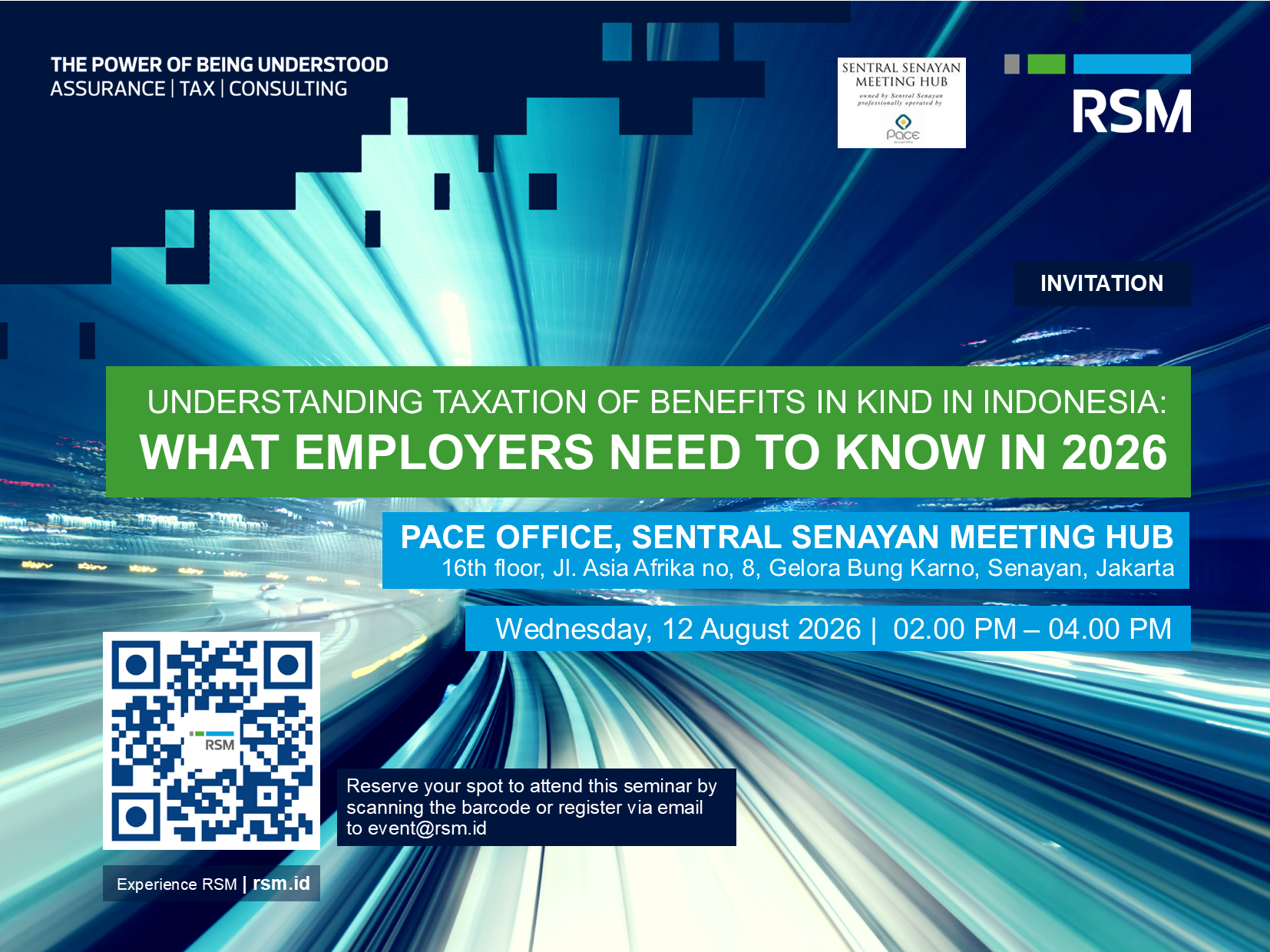
The taxation of Benefits in Kind (BIK) in Indonesia is complex. “BIK” include more arrangements than expected, and with limited exclusions/exemptions . With pressure on the Tax Authority to maximise tax revenue, and the implementation of more integrated tax reporting systems, companies are expected to carefully assess how benefits provided to employees are recognised in accounting systems, valued, and reported for tax purposes. In addition, the tax treatment of BIK is not just an employer issue, but has implications for the workforce if the impact is not well understood and explained. Thus, comprehensive understanding is essential to ensure compliance while managing workforce costs and employee relations effectively.
In this event, we will guide participants through the taxation of Benefits in Kind in Indonesia, discuss common challenges faced by employers, and explore practical approaches to structuring and reporting employee benefits. Participants will gain valuable insights into compliance requirements.
Register here!
Get to Know Our Members | HONEYWELL INDONESIA, PT.
 |
Honeywellis a Fortune 100 technology company that delivers industry-specific solutions, including aerospace products and services, control technologies for buildings and industries, and performance materials worldwide. Its technologies help aircraft, buildings, manufacturing plants, supply chains, and workers become more connected, making the world smarter, safer, and more sustainable.
Honeywell’s technologies have been distributed and installed in Indonesia since 1974. Since 1992, the company has operated several sales offices and manufacturing facilities to serve customers across Indonesia. For more information, please visit www.honeywell.com.
Now is the Time to Join AmCham!
 |
We offer a full slate of meetings, events, and information for our community. But we can only do this through the support of our members. If you are not yet an AmCham member please join now.
AmCham Indonesia is open to all companies with an interest in US business relations and we have many non-American members.
We are a community and we welcome you!
Reach us at membership@amcham.or.id or click below!
Update is AmCham’s regular newsletter on developments related to investment, the economy, regulations and issues related to doing business in Indonesia. It comes out three times a week. It is edited by AmCham Managing Director Donna Priadi and written by the AmCham Staff.